How to remember when you last did something
You are standing in front of the water filter wondering whether you changed it in June or the June before. You will make a decision in about four seconds, and it will be a guess.
This is not a memory problem. Nobody remembers dates for things they did once, months ago, while thinking about something else. It's a recording problem, and it has a handful of decent solutions — most of which are not apps.
1. Write it on the thing
The most reliable method ever invented is a permanent marker.
Date the filter when you fit it. Put a strip of masking tape inside the cupboard door and write the date on it. Stick a label on the back of the smoke alarm the day it goes up. The record lives on the object, so you can never be looking at the object and not the record.
This is unbeatable for anything physical you'll be standing in front of when the question arises. It fails for anything that isn't a thing — you cannot write a date on "called my parents" — and it fails when you want to know before you walk over there.
2. Photograph it
Every photo your phone takes is stamped with the date, which makes your camera roll an accidental logbook.
Take a picture of the new tyres, the filled-in service book, the boiler after the engineer leaves. Months later, find the photo and the date comes free. Better still, most photo apps let you search text in images, so a photo of a receipt or a service sticker is often findable by typing what it says.
Cheap, needs no setup, and you probably have years of accidental records already. The catch is retrieval: you have to think to look, and you have to find it among forty thousand other pictures.
3. A calendar entry on the day — not a repeat
Here is a small trick that works better than it sounds: when you do the thing, put a one-off event on today's date saying so.
Not a repeating reminder in the future. A log entry in the past.
Your calendar then becomes searchable history. Search "filter", get every time you changed it. It costs ten seconds at the moment of doing, and the record is somewhere you already look.
The limitation is arithmetic. The calendar tells you it was 14 March. It will not tell you that 14 March was seventeen months ago, and for anything older than a year most people genuinely cannot feel the difference between seventeen months and twenty-nine.
4. A running note
One note called "when I last did things", newest at the top. Honest, free, and no worse than the calendar.
Same problem, though: it stores dates, and the question you ask is about elapsed time. Every lookup ends in mental subtraction, and the subtraction is the bit your brain is bad at.
5. Something that counts for you
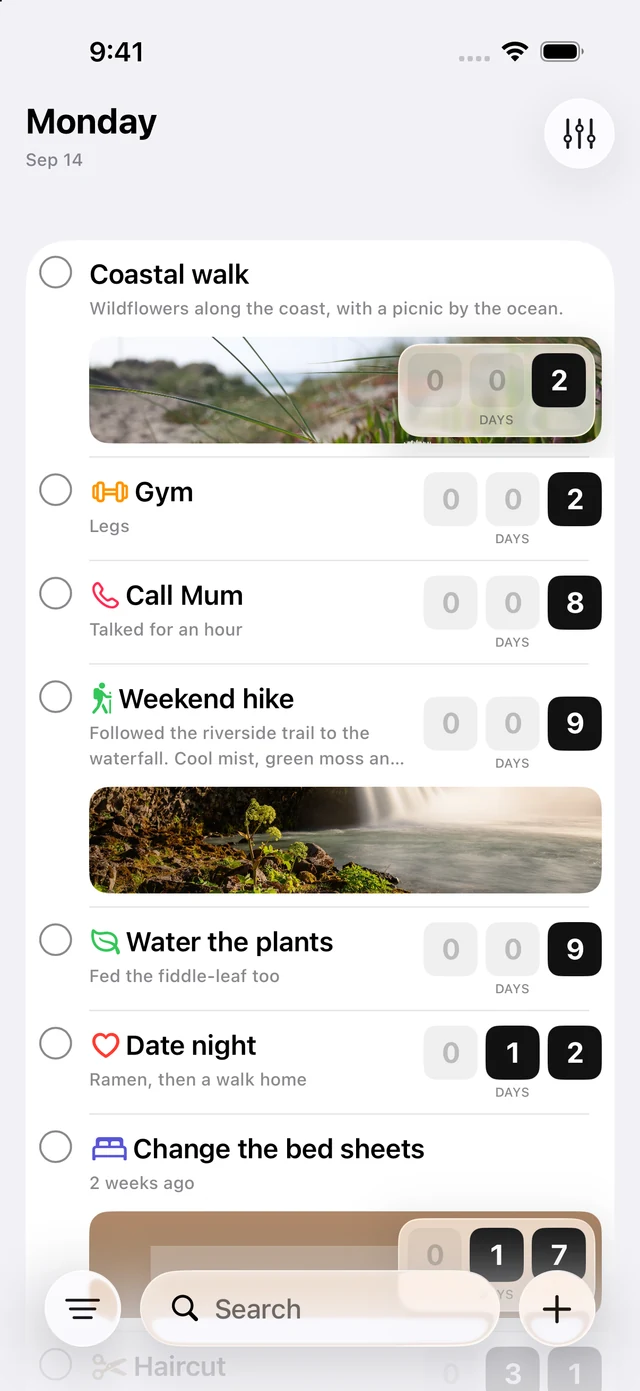
Which is where the fifth option comes in: an app whose entire job is to hold the date and show you the gap.
The difference is small to describe and large in practice. You don't read "14 March 2025" and work it out. You read 187 days and you're done. No arithmetic, no feel-for-dates required, and a number that is equally legible at nine days and at nine hundred.
The rule that decides whether any of this works
Every method above succeeds or fails on one thing: you have to record it at the moment you do it.
Not that evening. Not when you next remember. Then — with the watering can still in your hand.
This is the whole game. Any system you'll actually use in that ten-second window beats a better system you'll use later, because later does not arrive. It is also why the marker pen holds up so well against every app ever written: it is right there, and it takes four seconds.
So the practical advice is less "pick the best tool" than "pick the one that's nearest at the moment of doing". For things at home, that might genuinely be a label. For everything else, it's whatever is already in your pocket.
Two things follow from that:
Make capture cheaper than remembering. If logging costs more effort than the thing was worth, you will stop, and a half-kept log is worse than none because you'll trust it.
Put the record where the question gets asked. A perfect history in an app you never open is not a system. The reason dated masking tape works is that it is physically unavoidable.
Where the counting helps
There's a second benefit to recording every time rather than only the most recent one, and it's the part people don't expect.
Once you have two or three entries, you know your actual interval — not the one you assumed. Almost everyone discovers their real gap is longer than they'd have guessed. "Every three months" turns out to be every five. That's not a failure to be fixed; it's just information, and it's more accurate than the number on the packaging.
Last Time is built for this: add a thing once, mark it done when you do it, and it counts from there — with the whole history kept, so your own average gap emerges from what you actually did.
If you want the longer argument for why elapsed time beats scheduled reminders, it's in Reminder apps assume a schedule. And if you're after the actual intervals, how often you should replace things has the usual guidance for the household ones.