How often should you actually replace it?
Some things announce themselves. A bulb goes, a tap drips, a warning light comes on, and you deal with it.
The awkward ones are the things that degrade without ever telling you. A smoke alarm that is eleven years old looks identical to one that is two. A cycle helmet that took a knock in the shed looks fine. Tyres with perfectly legal tread can be old enough to have gone hard.
Below is the guidance most commonly given for these. Two caveats before the list, and they matter more than any number in it.
Your manual wins. Manufacturers specify for their own product, and where they differ from anything here, they are right and this is wrong. The same goes for your dentist, optician, vet or mechanic, who can see the thing in question.
These are typical, not universal. Several vary by country, by water hardness, by how much you use the thing. Treat them as a prompt to check, not a rule to obey.
Safety
| Smoke alarm — whole unit | 10 years from the date on the back |
| Smoke alarm — battery | Yearly, unless sealed for 10 years |
| Smoke alarm — test | Monthly |
| Carbon monoxide alarm | 5–7 years, per the manufacturer |
| Fire extinguisher — check | Monthly glance at the gauge |
| Cycle helmet | About 5 years, or immediately after any impact |
Smoke alarms are the one I would not eyeball. The 10-year figure comes from the NFPA and is about the sensor degrading, not the casing — there is nothing to see. The date is printed on the back of the unit, which is the only reliable way to know, and is also the reason this is worth writing down somewhere the moment you fit one.
A helmet after an impact is not a judgement call either. The foam is designed to crush once.
The bathroom
| Toothbrush or brush head | 3–4 months, or sooner if frayed |
| Contact lens case | About every 3 months |
| Razor blade | Every 5–7 shaves, roughly |
| Loofah or bath sponge | Weeks, not months |
The 3–4 month toothbrush figure is the ADA's, and frayed bristles override the calendar.
The car
| Tyres — age | Many makers say 6 years; 10 years is a common hard limit |
| Tyres — tread | Check monthly; legal minimums vary by country |
| Wiper blades | 6–12 months |
| Cabin air filter | Commonly 12–24 months |
| Engine oil | Entirely dependent on car and use — see the manual |
Tyre age is the one people miss, because tread looks fine long after the rubber has stopped behaving. There is a four-digit code on the sidewall: week and year of manufacture. 2223 is the twenty-second week of 2023.
The house
| HVAC or furnace filter | 1–3 months |
| Water filter jug cartridge | Usually 1–2 months |
| Gutters | Twice a year, more under trees |
| Chimney sweep | Annually if used regularly |
| Mattress | 7–10 years |
| Pillows | 1–2 years |
| Washing machine filter | Monthly-ish |
The ones with a date printed on them
| Passport | 10 years for adults in most countries, 5 for children |
| Driving licence photo | 10 years in many places |
| Travel insurance, breakdown cover | Annually, usually auto-renewing |
These are the easiest to track and the most annoying to get wrong, because the consequence arrives at an airport.
The interval is the least interesting part
Here is the thing this list cannot do for you: none of it helps unless you know when you last did it.
"Replace your smoke alarm every 10 years" is an actionable instruction only if you can answer "when did I fit this one?" Most people cannot, and the fallback — squinting at a faded date on a ceiling-mounted unit at arm's length — is exactly the sort of friction that means it never gets checked.
That is the gap. Not knowing the correct interval; knowing where you are inside it.
There is also a decent chance the published interval is wrong for you. Water filters in a hard-water area do not last as long as the box says. Wiper blades in a hot climate go faster. If you record what you actually did, the real interval emerges from your own history, and it is more useful than the number on the packaging.
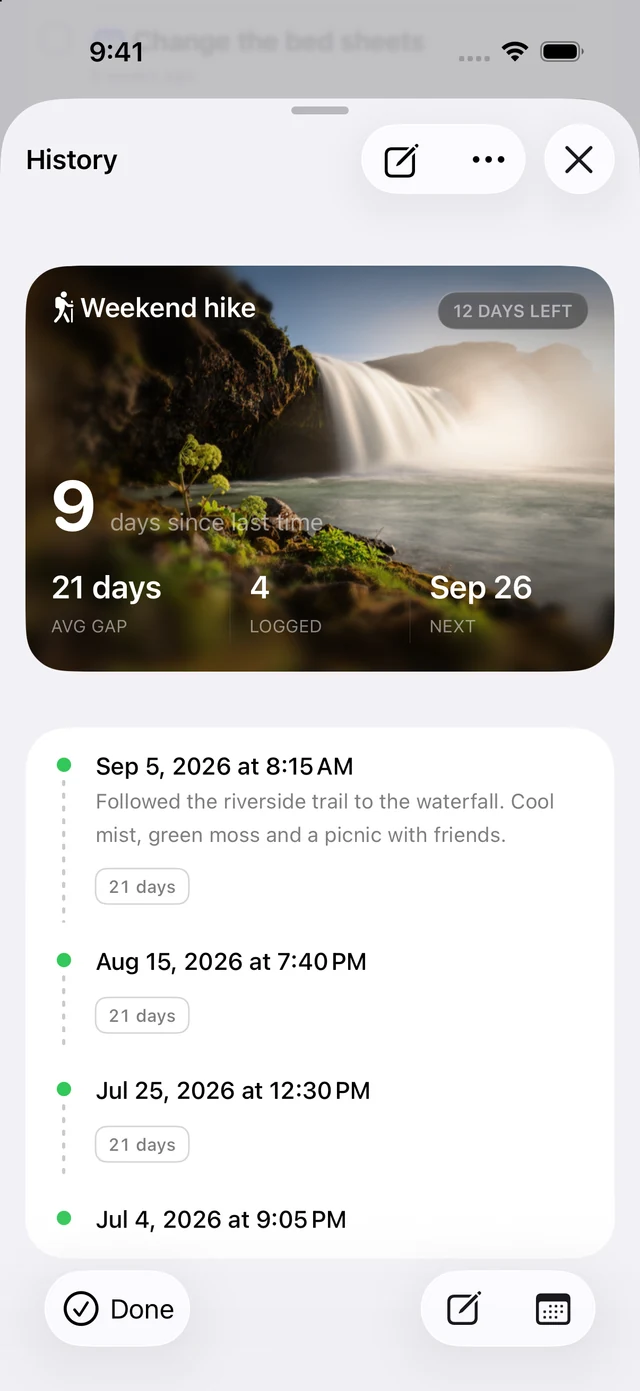
Last Time is built for exactly this: you record the thing once, mark it done when you do it again, and it counts the days from there. No due dates to guess at, no repeating alarm going off whether or not you acted on the last one.
The full argument for why elapsed time beats a schedule is in Reminder apps assume a schedule. The short version is that the calendar makes you guess the interval up front, and this way you find it out instead.