Reminder apps assume a schedule. Some things don't have one.
You know you should replace the smoke alarm batteries. You even remember standing on a chair to do it. Was that eighteen months ago, or closer to three years?
Most of us have a handful of these. The car's tyres. Contact lenses. Deworming the dog. Flipping the mattress. Calling your parents. Backing up the laptop to the drive in the cupboard, not just the cloud. None of them are urgent on any given day, which is exactly why they drift.
The strange part is that we have an enormous number of apps for remembering things, and most of them are bad at this particular kind.
The three tools people reach for
A repeating calendar event. This asks you to commit to an interval before you have any evidence. Every four months? Every six? You guess, and the guess is now a rule. Worse, it fires whether or not you did the thing. Miss one, and the next one arrives on schedule anyway, carrying no memory of the gap. After a few rounds you are snoozing an event that has stopped meaning anything.
A habit tracker. These are built around streaks, and streaks are built around daily. The good ones make a chain you don't want to break, which works beautifully for exercise or language practice. Applied to something you do twice a year, the model falls apart: there is no chain, and the interface spends most of its time telling you about a gap that isn't a failure. Nobody needs to feel guilty about the four months since they last descaled the kettle.
A note in the notes app. Honest and cheap, and it does hold the date. But it holds it as a date. "Replaced tyres — 12 March 2024" requires you to do the arithmetic every time you look, and dates from more than a year ago are peculiarly hard to feel. Most people cannot tell you at a glance whether March 2024 was eighteen months ago or thirty.
Each of these fails in the same place. They are all built around when it is due — a point in the future you have to nominate in advance.
The question is how long it's been
Turn it around. Don't schedule the next one. Record the last one, and let the app count forward.
| Smoke alarms | 412 days |
| Tyres | 683 days |
| Called parents | 9 days |
| Mattress flipped | 201 days |
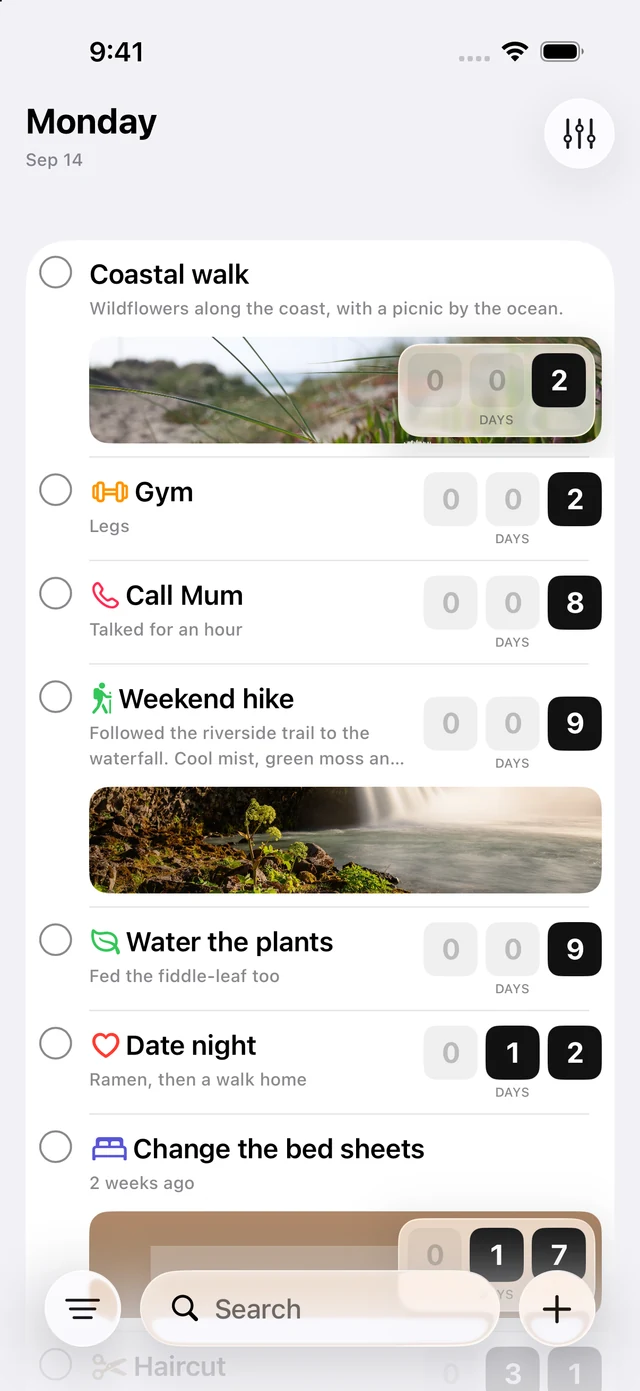
That is the whole idea, and it changes three things.
You don't have to guess the interval. You record what you actually did, when you actually did it. Do that twice and the app knows your real gap, which is almost never the one you would have typed into a calendar. My own "every three months" turns out to be every five.
Nothing nags you on a schedule. A number that has been sitting at 412 days is not an alarm going off at 9am on a Tuesday. It's a fact you can look at when you're in the right place to act on it — which for smoke alarms is when you happen to be near a chair and a pack of batteries.
A gap stops being a failure. There is no broken streak, because there was never a streak. There is a number, and the number is just true. That sounds like a small distinction; in practice it is the difference between an app you keep and an app you delete out of low-grade guilt.
When you genuinely do want a calendar
Plenty of things have real dates, and for those a calendar is exactly right. Rent. Birthdays. The MOT. A prescription that runs out on a particular day. Anything with a legal or financial deadline belongs in a calendar with an alert, and no amount of elapsed-time tracking improves on that.
The split is clean: fixed dates go in a calendar, elapsed time goes somewhere else. Most people only have the first kind of tool, so the second kind of thing ends up in the first kind of tool, fits badly, and eventually gets ignored.
What this looks like in practice
Last Time is built entirely around the second kind. You add a thing once, mark it done when you do it, and it counts the days from there.
Because it keeps every entry rather than only the latest, it works out your own average gap and uses that — not a number you invented — to sort the list into Overdue, This Week and Later.
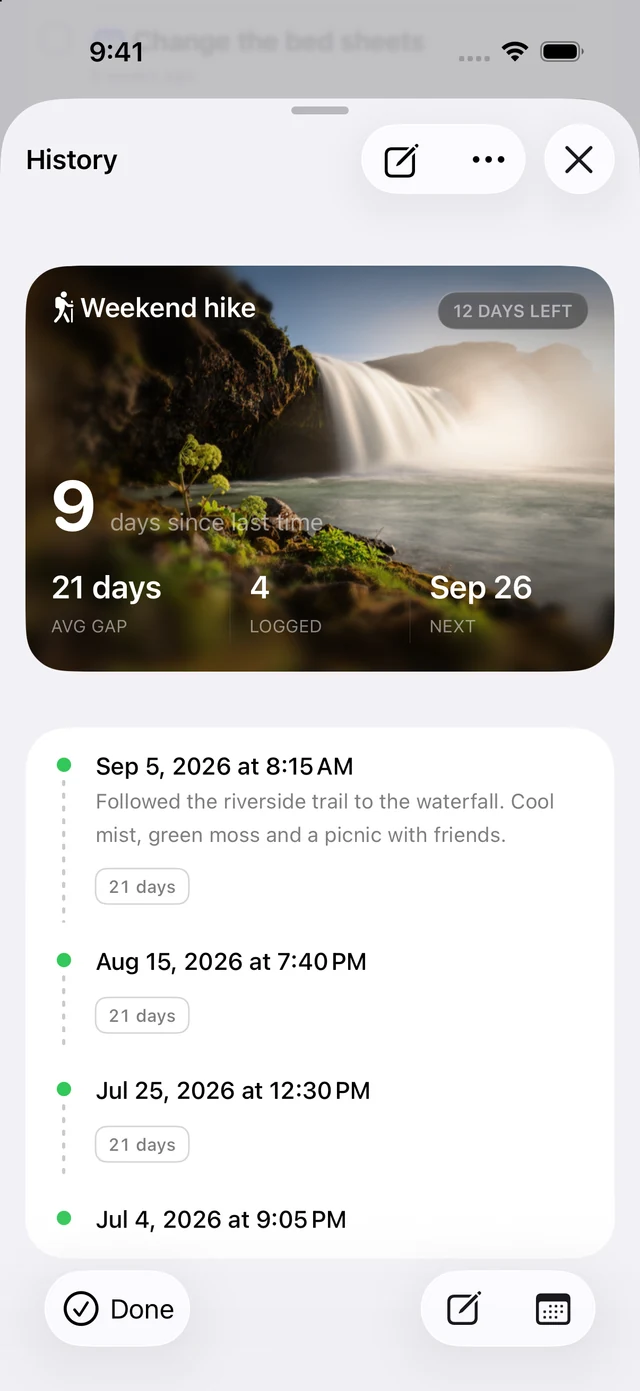

You can count in days, or in months and years for the things where days are absurd. A passport reading 04 years 00 months 29 days tells you something a date never will.
It has been on the App Store since 2012, which is long enough to find out that people use it for things I would never have thought of: battery life in a specific device, when the dog's nails were last clipped, how old the contact lenses are, the last time the spare room got painted. The pattern underneath is always the same. Not when is this due, but how long has it been — and that turns out to be the more answerable question.